15 June until 7 July, DLUL Gallery (Breg 22, Ljubljana)
Graphic art goes on
William Ivins, the first curator at the Department of Graphic Art at the Metropolitan Museum in New York, wrote in his book Prints and Visual Communication: “For practical reasons, classic engraving, mezzotint and reproductive etching have ceased to exist nowadays … As a medium that today still has something to say, the etching, except for its use in photographic processes, no longer has any power.” This was written in 1953. Today, we all know that he was wrong, because graphic art, including the etching, experienced a boom in the 1960s and 1970s and has expanded from its simple beginnings to the contemporary wider interdisciplinary space that covers a large part of postmodern practices.
Graphic art is a medium that is characterized by inventions, innovation and technological progress. Craftsmen and artists have always strived to ease their work and introduce new processes, new tools and new techniques. The history of graphic art shows how it is incredibly versatile and flexible and able to communicate its ideas in different areas. From the second half of the 20th century, we have been witnessing how new technologies are rapidly being used in graphic art, while traditional techniques are being transformed or replaced with new ones. For a long time, graphic art is no longer intended for cabinet reviewing, since the works that are being created today are much more complex and reveal the inherent functioning of graphic art in the public sphere. The world of digital production and communication has incredibly transformed the ways of artistic creation, production and dissemination. Contemporary graphic art is able to combine physically long-lasting and strenuous graphic art techniques with new technologies, brought by, among others, photography, design, mass media, computers and related new tools.
The old rules and structures of the graphic discipline have been redistributed or are no longer abided by; the aesthetic boundaries began to disintegrate at the expense of changes, flow and excesses. Today, graphic art seems to be an ubiquitous medium, since it has opened up a whole range of domains that were previously reserved for other art categories. Numerous contemporary graphic works reflect the pluralistic nature of contemporary art.
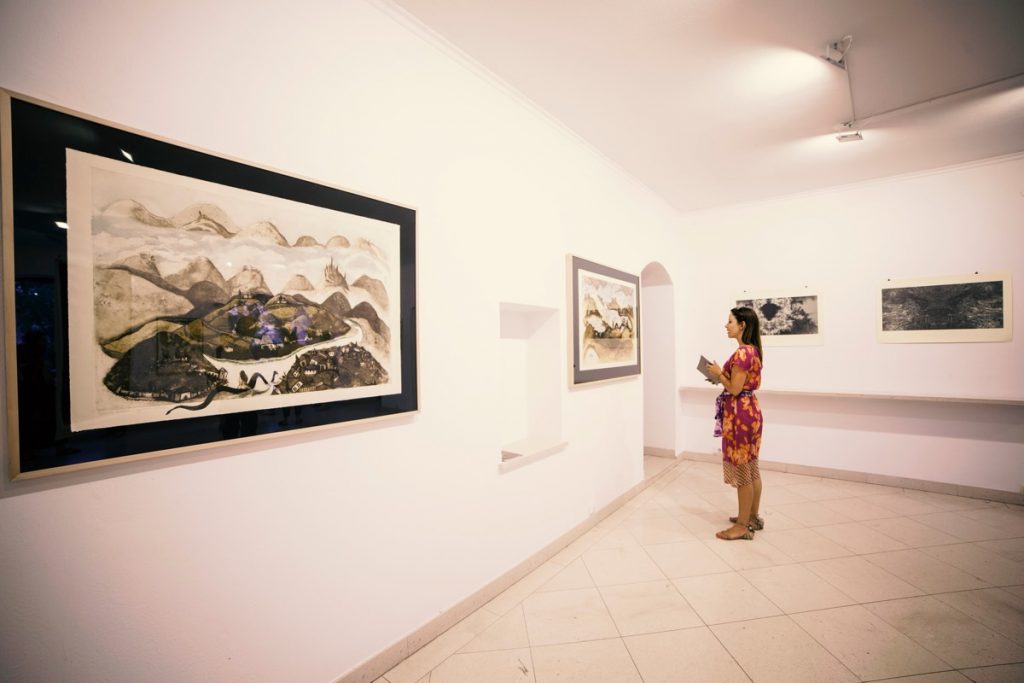
At the exhibition Avanti Graphic! 2# in the DLUL Gallery, six artists will present their graphic explorations. Each of them approaches the medium differently, serving them as a mediator of ideas, knowledge or reflection.
Nevenka Arbanas is called the first lady of Croatian graphic art. In more than forty years of creation, while experimenting with graphic techniques and materials, she has developed her graphic knowledge and skills to exquisite graphic creations. She creates in etching and aquatint techniques in combination with linocut, which indicates her tendency to experiment. She pays special attention to the choice of paper and she is also fond of large formats. In the DLUL Gallery, she is presenting her work with two monochrome graphics of a monumental format from 2012. The two graphics formally continue the research that began with the Leaves (Listi) series. That her research has directed away from the previous, more narrative content is shown by the titles of the graphics, which she names only with a letter and numbers. She thus implies that she is interested in different content, which she combines with visual elements from her older works. She uses linocut in a template manner and prints it over an image created in deep print techniques. This creates a sense of three-dimensionality, which is supported by the placement in the ambience of the exhibition space. In her extensive graphic oeuvre, Nevenka Arbanas also dedicated special attention to the use of colour in graphics. The colour addresses us from the works in the poetic graphic folder, which was created in 2001 at the Edina Publishing House as a collaboration of the artist and the poet Tone Pavček.
Admir Ganić, an artist of the younger generation, who studied at the Academy of Fine Arts in Sarajevo, is a graphic artist, who devoted himself to the deep print techniques. His works are figural and the narration is connected with the tradition of Bosnia and Herzegovina, from where he originates. The artists is presenting his works from 2016 entitled Scenography for Sevdah (Scenografija za sevdah). The term sevdah in Bosnian language means craving, love passion, sadness and is also in a wider sense connected with the notion of a painful love and longing for love. Ganić’s graphics in a combination of colour techniques of deep print depict the familliar Bosnian landscape with a typical landscape iconography, in which the artist symbolically incorporates the love-sexual motifs with the image of a woman riding a snake or a bride who is a snake whose body is winding through the landscape. The graphics reveal the technical mastery in drawing and the use of colour as well as the love for detail. Through the emotional states that are most easily expressed particularly through sevdah, the folk song, which the artist is transmitting on paper through the matrix, the artist’s attachment to his home culture and perhaps even a tinge of homesickness are shown.
The artistic development of Sonja Vulpes was strongly marked by a subcultural punk scene and the zine production. Sonja Vulpes expresses herself primarily through drawing, which lives independently, in the graphics or tattoos. Last year, attention was drawn to her graphic cycle entitled Memento Mori, created in colagraph and monotype techniques. In the DLUL Gallery, she is presenting herself with three colagraphs from the series Undressed (Slečena), which places a naked female figure to the forefront. We recognize it by the anatomy, while the heads are typified and act as some sort of diabolical emoticons. Colagraphy allows for a great deal of experimentation and a relatively gestual approach, while the possibility for larger edition is very limited as the matrix is quickly destroyed. It is more than obvious that the artist is not interested in the multitude of works, but rather the creative possibilities that the colagraphy process enables her drawing. The artist says that she is interested in graphic art, because of the preparation of a matrix, which requires conceptuality, thinking ahead, since the image effects cannot be achieved directly, but by using different processes and materials, such as sand, adhesive, etc.
Macedonian artist Vlado Goreski is presenting his latest works from two series: Shamans (Šamani) and Cathedral (Katedrala). In the Shamans series, in which some sort of stylized masks are placed to the forefront, which, as ghosts, wind from the black surface, the artist uses the traditional technique of lithography, supplemented by combined techniques. The Cathedral series, which is completely abstract and visually reminiscent of fractal images, is created in the digital press. The artist is not interested in colour; his graphics, despite using digital technology, remains black and white.
Sarajevo artist Renata Papišta thinks about graphic art in the expanded field. She combines traditional graphic techniques with new materials, technologies and methods. She is looking for the ways out of the traditional concept of graphic art and the ordinary ways of presenting graphic prints; she creates installations and site specific placements, recently also the books of an artist. Her works function at the border of a graphic, photograph and an object. At the core of her creation, drawing and a traditional graphic technique are most frequently ready for experimentation. In her work, she focuses on the issues of the flow of time, the transformation of motifs and forms in a work of art etc. Her work from the cycle Reflections (Refleksije), 2019, in combined techniques, has a transformative character since it adapts to the exhibition space. The abstract image, printed on a transparent surface for additional effects, exploits the lighting. The reflection acquires multiple meanings in terms of content and a time dimension through the shadows on the walls.
In Slovenia, Leon Zuodar is best known for his zine production and publishing and as a member of the Art Group Beli sladoled (“White Ice Cream”). He primarily expresses himself through drawing, while he is also engaged in graphic art and painting. For the exhibition in the DLUL Gallery, he prepared a site specific installation in the gallery niche. The work entitled I I I I I I I I I was created in 2016. It is a conceptual work composed of nine screen prints on canvas with the addition of a red tailor’s thread. On a double-sided printed canvas, a photograph (taken in 1964) by Lucio Fontana during his intervention in the canvas is printed and over it, with a red thread, Zuodar sewed the lines of different lengths, going in different directions. It is the artist’s unique reflection on the painter Lucio Fontana and his actions of making cuts in the canvas; on a symbolic level, the work can be understood as the artist’s attitude towards painting and his own production. Leon Zuodar is known for his specific fast, small line drawing and so the stiches across the printed canvas can also be understood in this context.
The exhibition in the DLUL Gallery is consolidating the belief that the contemporary graphic scene is as wide and varied as it can be imagined. On the one hand, we have the artists who are trying to expand the boundaries of graphic art through new technologies and range or by combining graphic processes with sculpture, installation, performance and other media, and on the other hand, many artists still present the contemporary content in a more “traditional” way. All the while, graphic art remains a matter of choice when we want to express something in a specific way. Let me conclude with the words of Hugh Merrill[1] that graphic art is in its content a bulwark of versions and creativity, blessed with almost infinite variations.
Mag. Breda Škrjanec
[1] Hugh Merrill is an internationally renowned American artist in the graphic community. He writes articles on the redefinition of art, education and graphic art. He lectured about graphic art and taught it at more than 75 universities and art schools around the world.
***
Photo: Urška Boljkovac. Archive: MGLC.
